- Lessons in an app that barely covers Shona
- Word games, none of them in Shona
- Conversation practice with an expensive tutor, on a schedule
- Vocabulary in flashcards, in yet another app
- Pronunciation from YouTube, and hoping for the best
- Culture and proverbs scattered across blogs and family WhatsApp

Find your way back to Shona.
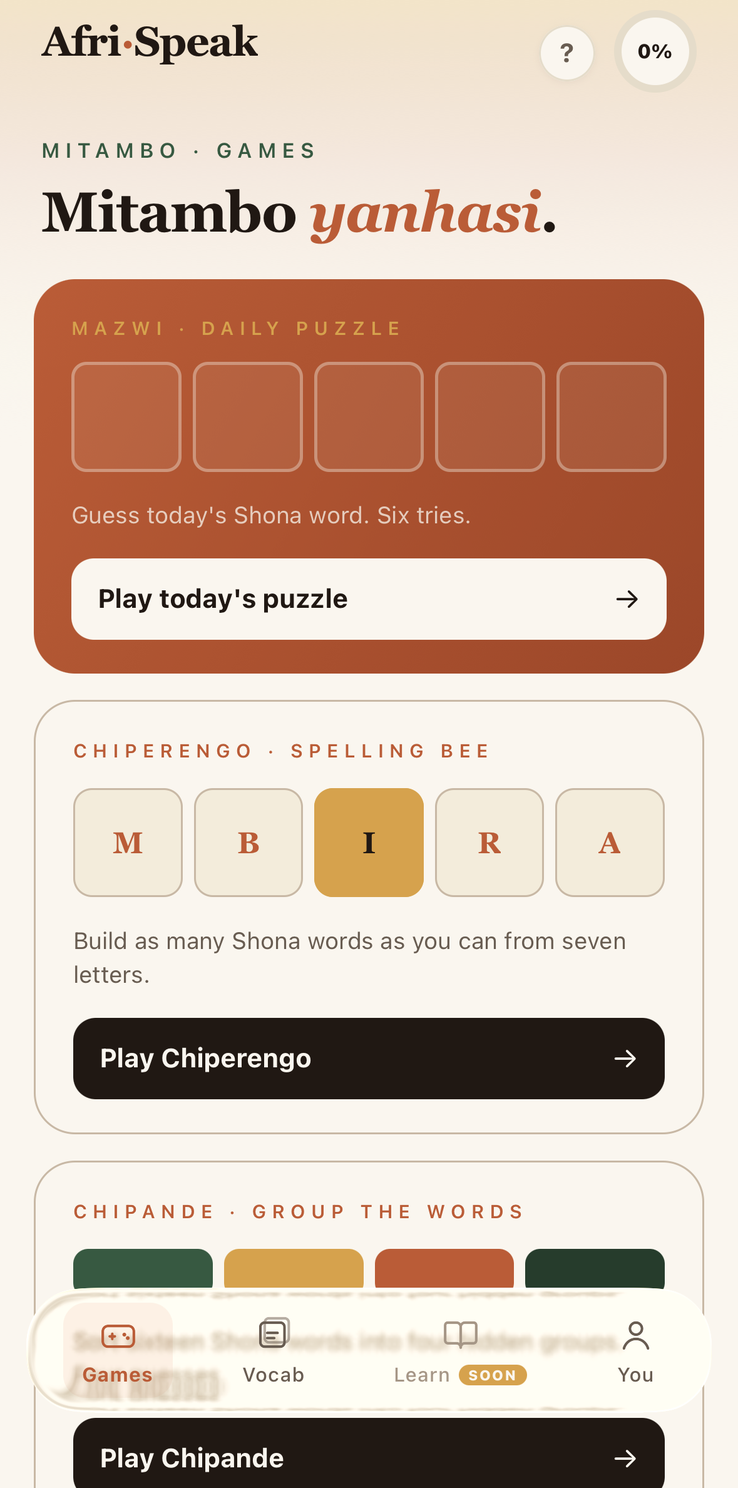
Show what you know and grow your vocab in daily games like Mazwi, Chiperengo and Chipande. The vocab deck brings back the words you miss until they stick.
- Daily games
- 3
- Everyday words
- 500
- A day is enough
- 5min

Stop juggling apps.
Learning Shona has meant a different tool for every piece, and giving up on most of them. Afri-Speak is one place for all of it, built up a piece at a time.
All of it. One app.
Today that means three daily word games and a vocab deck you review like flashcards, all drawn from a real Shona dictionary and the way people speak now. Lessons, pronunciation and a tutor you can talk to are being built on top of that.
The waitlist gets you the launch note, and a hello from Tanya before then.
For anyone coming home to Shona.
You moved away and the language didn't come with you.
Wherever you ended up, there is nobody around to practise with. Afri-Speak fits into the slivers of time you do have, on the bus or before bed.
You can follow the conversation but can't quite join in.
There is no classroom here and nobody watching. Practise on your own until the words feel like yours.
Reaching back to a language that's part of you.
Spouses, partners, grandchildren, friends. If you are stepping into Shona from the outside, you are welcome here too.
Every way back.
Games and vocab you can use today. Lessons, pronunciation and a tutor after that.
Mazwi, the daily word
One Shona word a day, six tries to guess it, Wordle-style. Every answer comes from a real Shona dictionary, so you are never guessing at made-up words.
Chiperengo, the spelling bee
Seven letters and as many Shona words as you can build from them. It is harder than it looks, and a good way to learn how words are put together.
Chipande, group the words
Sixteen words hiding four groups. Sort them and you learn which words belong together and why, which is most of what fluency is.
Vocab that sticks
A deck of 500 everyday words. Flip a card, say how well you knew it, and the app decides when to show it again. Words you struggle with come back sooner.
A streak that counts real practice
Set a daily goal in minutes. Hit it and the day counts. Miss one and the app does not make a thing of it.
Later: a tutor you can talk to
Shona conversation at your pace, with pronunciation feedback and proper lessons. We are building it after the games and the vocab deck have settled with the first testers.
The questions everyone asks.
Is Afri-Speak like Duolingo for Shona?
Duolingo does not offer Shona at all, so in that sense there is nothing to compare. Today Afri-Speak is three daily word games and a vocab deck, all drawn from a real Shona dictionary and the language as Zimbabweans speak it now. Lessons and a tutor you can talk to come later.
Will it work if I already understand Shona but can't speak it?
Yes. That is the most common starting point, and the placement check is built around it. The games and the vocab deck rebuild the words first. Speaking practice arrives with the tutor in a later release.
When does the tutor arrive?
After the games and vocab have settled with the first testers. The plan is a tutor you can talk to in English while it answers in Shona, then flip to Shona-only when you are ready. There is no date yet, and we would rather ship it right than early.
How is this different from a textbook or YouTube?
Textbooks teach grammar nobody uses on a call home, and on YouTube you only watch. Afri-Speak makes you produce the words, six tries at a time, and remembers which ones you got wrong so they come back sooner.
What does Afri-Speak cost?
Pricing is not final. The plan is a free tier with the daily games and the vocab deck, and a paid tier, probably under five US dollars a month, for the tutor and pronunciation feedback once they exist. Everyone on the waitlist gets early access pricing.
When does it launch?
The iOS beta is on TestFlight now with a small group. A public App Store launch is planned for later in 2026. The waitlist gets the launch note.
Will there be Android or web versions?
Android is next, once the iOS beta has settled. A web version is further out.
Can my kids use it?
It is built for teens and adults reclaiming the language, but the content is family safe and works for confident readers. A kids track with Shona stories is on the list for later.
How a day goes.
- 01
Tell us where you are
A two-minute placement check. Maybe you understand a lot but never speak. Maybe you are starting from zero. Either way it picks your first words.
- 02
Pick a daily goal
Five minutes, or fifteen if you have them. The streak counts the days you hit the goal, and skipping one does not wipe it out.
- 03
Play, review, repeat
Today's Mazwi, a few vocab cards, maybe a round of Chipande. After a few weeks the words start turning up when you call home.
“Kuziva mbuya huudzwa.”
To know your grandmother, you have to be told. Nobody inherits a language on their own. Someone hands it over, or it stops.

Note from the founder
“I built Afri-Speak because nothing else met me where I was.”
I grew up in Harare understanding more Shona than I could speak. School pulled me in one direction, family in another, and somewhere between the two the language quietly became something I recognised but didn't use. Eventually I'd stopped trying.
Afri-Speak is the app I wish had existed back then. Patient, private, and built by someone who knows what it's like to almost speak the language of your own family. If that's you too, I'm so glad you're here.
— Tanyaradzwa Gozhora, founder
The first 1,000 spots come with early access and a thank-you from us.
Drop your email. We send one note when Afri-Speak goes live on the App Store, and a hello from Tanya before that.